

Starting my second year meant diving deeper into technical subjects, which was both terrifying and exciting. Already expected high pressure and demanding schedule also meant I needed to mentally prepare for a new challenge: learning Houdini. I had no prior experience with the software, but I had heard plenty of stories about how difficult it was to learn. When our instructor showed us this image below on the first day, it just confirmed what I already suspected—Houdini is tough, and I was going to struggle.
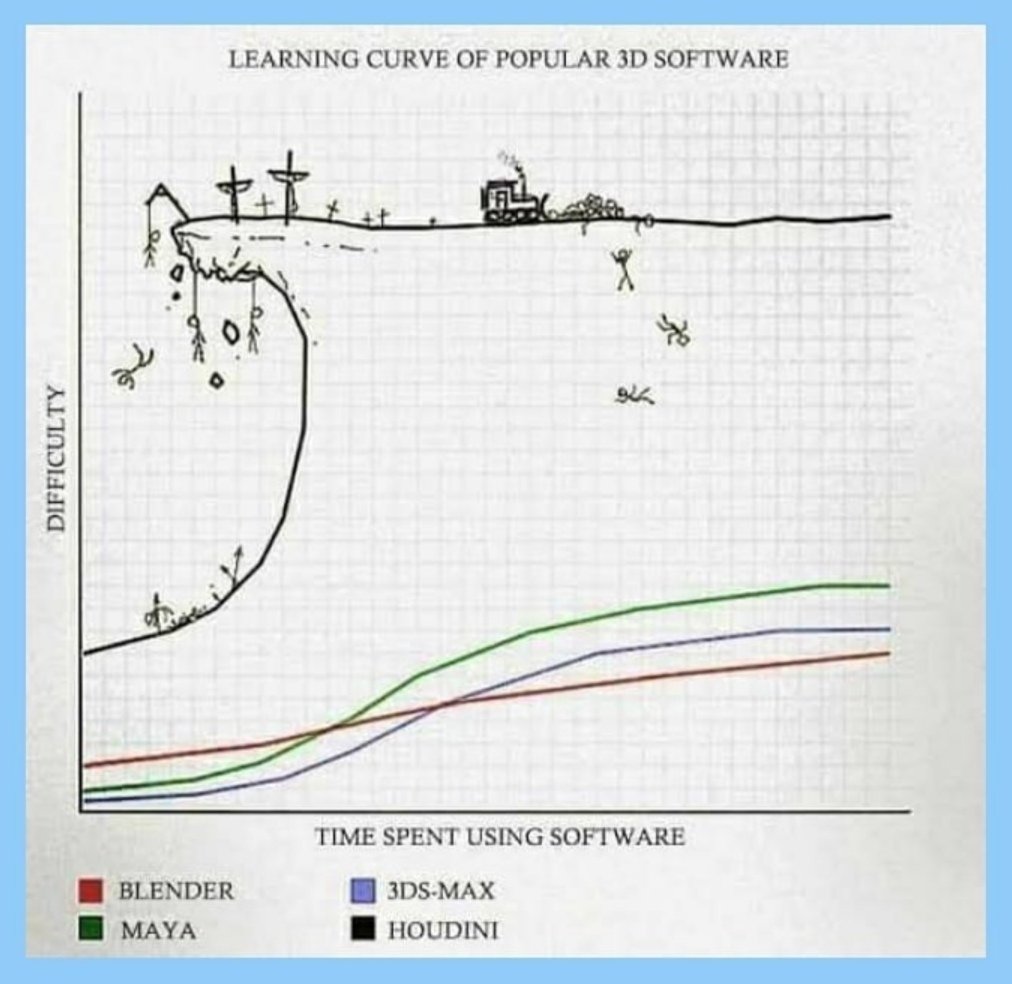
But perhaps that sense of challenge was exactly what pushed me to work harder. Instead of giving up when things got complicated, I made a conscious decision to stick with it and really understand the material. Now that my 5-week course is over, with about 100 hours spent in Houdini, I’ve realized what might be good way to approach learning this software. Here are 10 tips that helped me get through the first hill:
1. Choose an Area of Focus
Houdini is complex and can do many different things, so trying to learn everything at once will only lead to confusion. Pick one area that excites you, whether it’s cloth simulation, destruction, pyro or something else. Focusing on a single area you like keeps you motivated when things become difficult.
2. Find a Good Course
If you want to accelerate fast you need some guidance, otherwise it’s pretty easy to get lost quickly. Random tutorials might seem helpful at first, but without clear structure you’ll likely get lost. Our teacher recommended us to follow Christian Bohm’s course, which was $33/month with a student discount. Personally I really liked his teaching style and emphasis on fundamentals which helped me understand Houdini better in general.
3. Don’t Just Follow Tutorials
It’s tempting to follow along with tutorials step by step, but this approach won’t get you very far. Instead, watch the tutorial first, then try to recreate the process from memory. This takes extra time and energy but it’s more effective in a long run. As you progress, challenge yourself to solve problems before checking the instructor’s solution.
4. Put in Focused Time
Learning Houdini—or anything really—requires serious time commitment. But it’s not just about hours, it’s about focused hours. Be mindful of distractions like phones or web browsing. True progress comes when you’re fully engaged.
5. Use the Pomodoro Technique
I used Pomodoro method to track my focused time and become aware of how much time am I actually putting into studying. On the other hand, it made me take intentional breaks where I would get away from desk, drink some water and put my brain into a rest mode so it can process all the information. I also realized that my maximum effective focus time was about 6-7 hours a day, which helped me plan my study sessions more realistically.
6. Adopt a Growth Mindset
Above all else, this one is most important key to mastering Houdini—or any other challenge. You must believe that you can learn anything, even if it feels impossible at first. There is no tech person or non-tech person, there is just a person who either wants to learn or doesn’t want to learn. Whenever I hit a roadblock, I reminded myself: “I can figure this out. I just haven’t found the solution yet, but I will.” That mindset was a game changer in keeping me persistent.
7. Find a Study Buddy
If you’re in a school setting, take advantage of your peers who are going through the same difficulties as you. Discussing challenges with others often opens your eyes to different approaches. If you’re studying solo, join forums or Discord groups. Sharing your questions or work with others will help you learn faster and feel less isolated.
8. Google Everything You Don’t Understand
Never skip over a concept you didn’t fully grasp. Houdini involves a lot of math and physics, so if something doesn’t make sense, look it up immediately. The goal isn’t to breeze through tutorials—it’s to truly understand the material.
9. Learn VEX Gradually
VEX scripting is intimidating at first, but don’t stress about it early on. Focus on learning it as it becomes relevant to your projects. Over time, it’ll start to click, and you’ll see how knowing just a bit can be powerful.
10. Create a Node Library
Houdini is all about nodes, and there are hundreds of them. Taking notes was good way to internalize concepts better. Even though I didn’t refer to it often, just writing things down helped me remember the most common nodes and find the patterns.
These tips aren’t the ultimate guide to learning Houdini—everyone’s journey is unique. Still Houdini was difficult but these are the things that helped me get through those moments, get comfortable with the software and achieve my goals. At the end of the course, I completed my project and was happy with the result.
For a while, I wondered: do we love things because we’re good at them, or do we become good at them because we love them? Now I know the answer—once we push through the hard part, we usually start loving what we do because we’ve put in the time and effort to get good at it.
 Render & Roam
Leave a comment